








































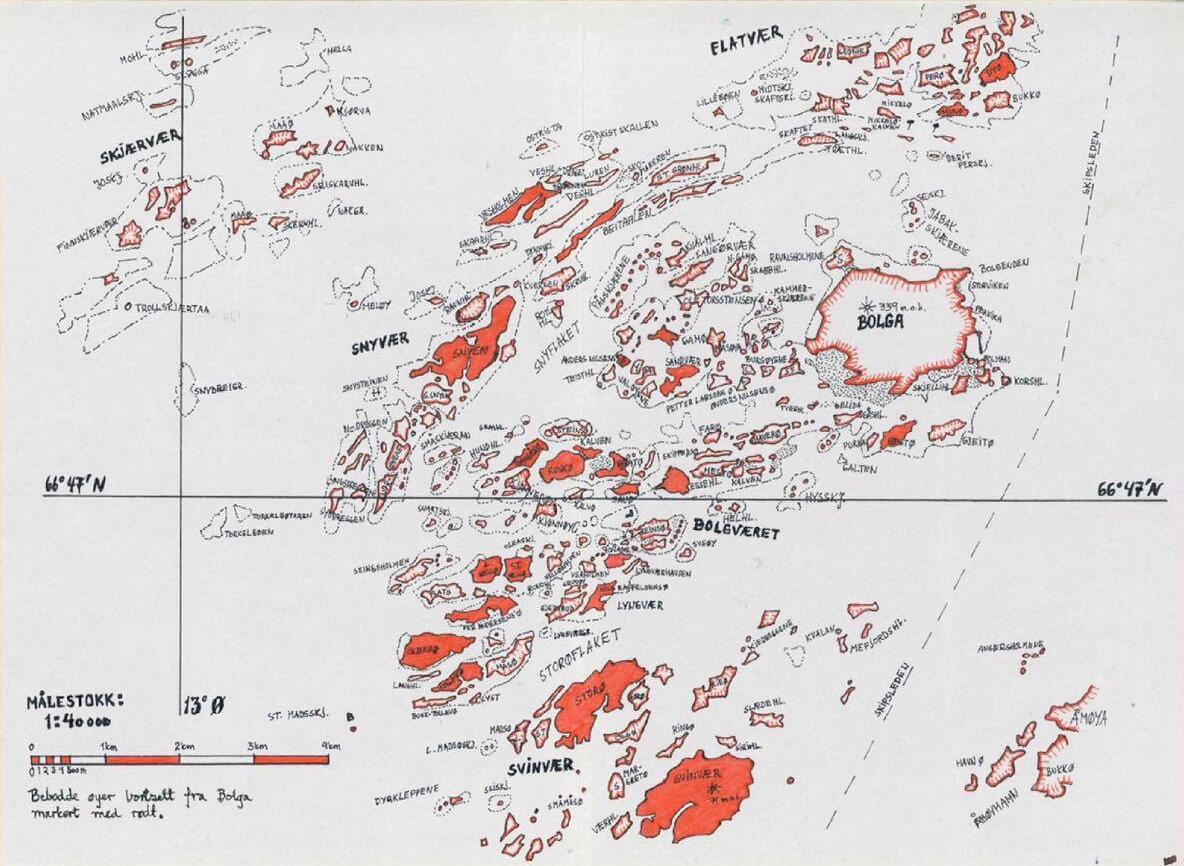
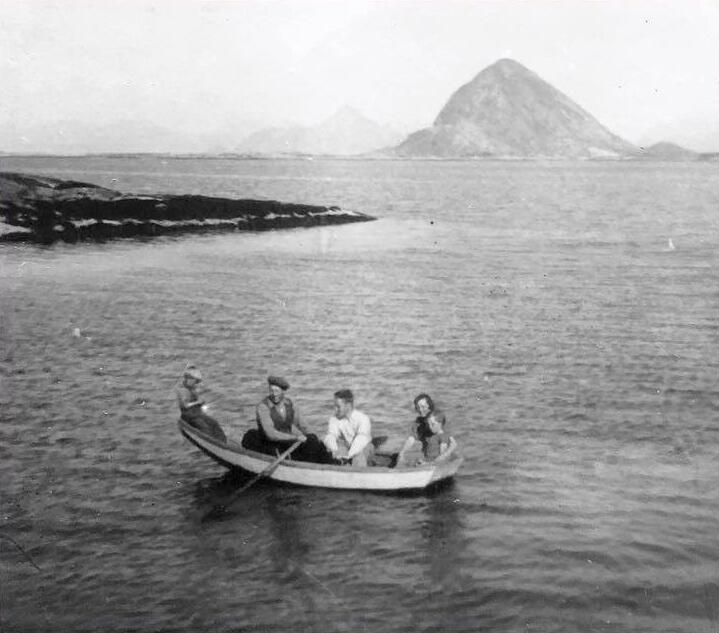

Even before my time, the islands has been a resource for the community. Here there were fishinghuts and quills which were used extensively in connection with fishing and hunting, but also in the important collection of eggs and down.
They were also used for grazing. And in 1831, the largest islands in Bolgværet were assigned to the individual farms on Bolga. This led to the individual user being able to rent out to people out on the islands.
The oldest settlement on the islands around Bolga was on Snyvær, furthest to the west. The main island was already settled in the 1620s and later also Vessholmen and Beitålen
In comparison, the first settlement on Bolgvær was only in 1842. Then Anders on Tollevøen sent his daughter to school. Beyond the 19th century, settlement accelerated and by 1865 three islands were settled. 10 years later, 12 families live on 9 islands. All are tenants, and most come from Rødøy and Lurøy. The work obligation for tenants was usually 3 days’ work on the main farm at Bolga.
In Bolgværet you could have the necessary agriculture and of course there was great proximity to fishing. Here you could also hunt for the valuable otter skins and fatty seal. It could be harvested from nature's abundance of bird eggs and mulberries. Nevertheless, perhaps the blessed eider bird was the most cherished. Many of the islands had several hundred nesting eiders. These yielded plenty of eggs, and not least the valuable down, which was worth its weight in gold. The egret was well looked after.
Yes, even the cat had to be on a leash during the egg period.
The most important and active period in the island's history is the large herring fishery in the 1870s. Several hundred men fished with nets, and there was also a large number of seine farms with close to 200 men. At most there were close to 50 sailing vessels that bought and salted the herring. The peak year was 1873, with a total of 632 registered people fishing in the islands.
In 1900, there were 33 people living in Snyen, and 5 of them had now become landowners and were thus masters of their own island. Nevertheless, there were still 12 tenants on the total of 15 inhabited islands. In total there were then 106 permanent residents on the island, while there were 103 on Bolga itself.
Contact with the outside world was important for those who lived out here. Mail shuttles and school shuttles started in the 1920s. And the telephone was developed in the mid-1930s.
After the second world war, however, development went in the opposite direction. People now began to move from the islands. The decisive turning point was when electricity was to enter the many Norwegian homes. For those who lived out here, the choice was between electricity and relocation allowance. Only Brattinden and Ruskøy had electricity developed, the others chose the latter.
Apart from a minor upswing in the first half of the 1960s, when fish farms and trade were established on Snyen, the development continued in a negative direction. And already at the transition to the 1970s, Snyen was also deserted. And with that, 350 years of settlement were over.
Subject text: Per Swensen, Anne Marie Johnsen, Tone Lise Lyngeng
Screenplay: Helge Seim
Voices: Tone Lise Lyngeng
Editing: Helge Seim
Soundrecordings: LydBerger Sunflower Studios.
Music and Soundeffect: freesound.org
Source:
- Fygle S. (1991) Fiskerihistorie for Meløy 1850 - 1991
- Moe K. (1981) Gård og grend i Meløy, bind 1
- Interview with people before 1980.