












































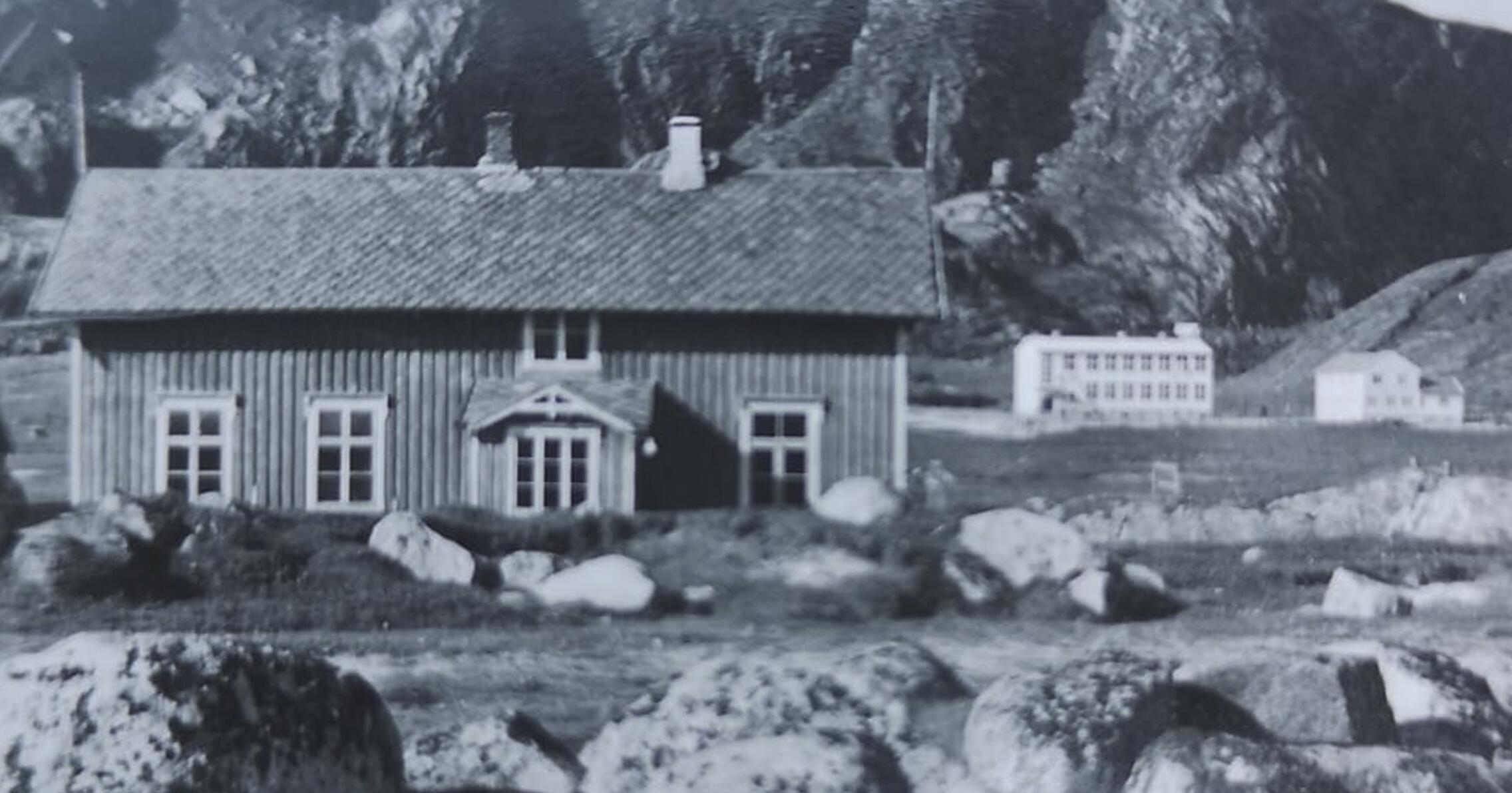

As Bolga’s population was increasing in the latter half of the 19th century, the population demanded that a permanent schoolhouse was to be built.
The letter to the municipality states:
"The only house that can be rented for a school is so low under the roof that it is difficult to endure, at the time of the year when the windows and doors must be closed".
Yes, it can be difficult enough to learn what is written on the blackboard. Especially if not enough light is let in for you to even see the blackboard.
In 1891, construction began and already the following year the new school was finished. In addition to the fact that everything had now become state-of-the-art, a permanent teacher was employed.
This was a so-called boarding school with the possibility of overnight accommodation for both the teacher and the children who had to be transported in from the surrounding smaller islands. There was a dormitory for the girls and one for the boys, each with 6 beds.
It was all well and good, but still the population at the time was so high that students often had to sleep two in each bed.
In addition, there was a dining room, kitchen and a classroom on the ground floor. Until electricity came in 1951, the only source of heat was a tall round wood stove.
Since the children from the islands lived at the school, they brought the necessary clothes, bedding as well as food for cooking.
In the beginning, the teacher was the only adult in the school, and since his focus was primarily the academic variety, the older children had to look after the younger ones.
This changed when the teacher moved out of the building at the beginning of the 20th century and left the bedroom to the newly hired female caretaker. She was called “pedell” and was responsible for both the building and the students well-being. Nevertheless, it should be mentioned that the big boys usually had to help her bring in water from the well and fetch wood from the outhouse.
In the early days, it was the parents who had to transport the pupils from home, but this changed in the 1920s when municipal school transport was introduced. In that period, a stone quay was also built by the Yttersjøen, to facilitate the disembarkation of the school children.
In the school year 1938-39, the youth center was used to teach the youngest pupils.
But it was a short-lived affair. A few days before Christmas in 1939, there was a violent storm that damaged many houses and barns. Yes, the wind was so infernal that it lifted the Youth center off its foundations and carried it to the other side of the road.
After the ravages of the storm, the church was put into use for the younger classes. This became common practice and was just as such until the new school was finished in 1956. This school is the one been used today.
Subject text: Per Swensen, Anne Marie Johnsen, Tone Lise Lyngeng
Screenplay: Helge Seim
Voices: Tone Lise Lyngeng
Editing: Helge seim
Soundrecordings: LydBerger Sunflower Studios.
Music and Soundeffect: freesound.org
Source:
- Braseth P. (2006) Skolen i Meløy, tiden før 1860
- Swensen P. , Torsvik U. og Schulz H.(1984) Jubileumsskrift Meløy kommune 1884 - 1984
- Kommunestyre og formannskap protokoller 1884 - 1945
- Interveiw with older people before 1980